
Search is no longer what it used to be.
For years, businesses relied on Local SEO to rank higher on Google, drive clicks, and convert customers. But today, that model is shifting fast.
Users are no longer just searching, they’re asking.
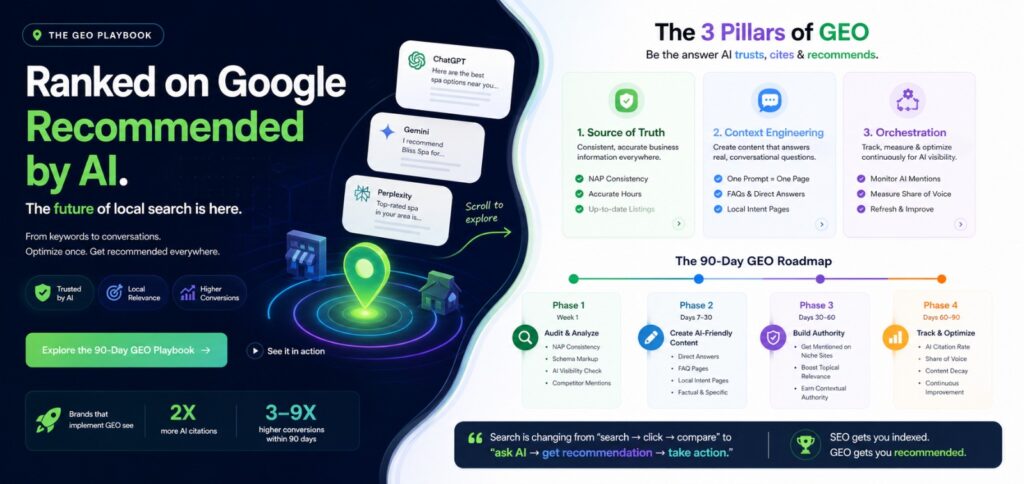
And instead of browsing websites, they’re getting direct answers from AI tools like ChatGPT, Google Gemini, and Perplexity.
This is where Generative Engine Optimization (GEO) comes in.
If you’re still focusing only on traditional Local SEO, you’re already behind.
What is Generative Engine Optimization (GEO)?
Generative Engine Optimization (GEO) is the process of optimizing your brand so that AI tools recommend and cite your business in their responses.
Unlike traditional Local SEO, where your goal is to rank on search engine results pages, AI search optimization focuses on becoming part of the answer itself.
Example:
- Old way: Rank #1 for “best spa in Kolkata”
- New way: Get recommended when someone asks “Which is the best spa near me?”
That’s a completely different game.
Why Local SEO Alone is No Longer Enough
Let’s be realistic.
Even if your website ranks well:
- Users may never click it
- AI tools may summarize your competitors instead
- Your brand may be completely invisible in AI responses
This is the biggest gap in today’s digital marketing.
The shift:
| Traditional Local SEO | Generative Engine Optimization |
| Focus on rankings | Focus on recommendations |
| Click-based traffic | Answer-based visibility |
| Keywords | Context + trust |
| Backlinks | Citations |
If you’re not optimizing for AI search optimization, you’re missing high-intent users.
How AI Decides Who to Recommend
AI tools don’t “rank” like Google.
They evaluate:
- Consistency of your business data
- Reputation across platforms
- Content clarity and usefulness
- Mentions and citations
This is where a strong GEO strategy becomes critical.
Pillar 1: Data Consistency (Foundation of Local SEO + GEO)
Before anything else, your business must be 100% consistent everywhere.
This includes:
- Name, Address, Phone Number (NAP)
- Business hours
- Services
- Website details
Even small mismatches reduce trust.
Why it matters for AI search optimization:
AI cross-checks multiple sources.
If your data conflicts → you lose credibility → no recommendation
This is where traditional Local SEO still plays a role but now it’s just the foundation.
Pillar 2: AI-Optimized Content (The Core of GEO)
This is where most businesses fail.
They write blogs for:
- Keywords
- Rankings
But AI prefers:
- Clear answers
- Structured content
- Real user intent
What works in GEO strategy:
- Question-based headings
- Direct answers in first 2–3 lines
- Simple, factual language
- Updated and relevant content
Example:
Instead of:
“Top Spa Services in Kolkata Explained”
Write:
“What is the best spa in Kolkata for relaxation?”
That’s how Generative Engine Optimization works.
Pillar 3: Authority & Mentions (The Trust Layer)
Backlinks still matter but not the way you think.
AI doesn’t just count links—it evaluates:
- Where your brand is mentioned
- How often you’re cited
- Context of those mentions
Focus on:
- Niche directories
- Industry blogs
- Local platforms
- Reviews
A strong GEO strategy prioritizes relevance over volume
Pillar 4: Continuous Optimization (Not One-Time SEO)
Here’s the reality:
GEO is not a one-time task.
You need to:
- Track where your brand appears in AI responses
- Monitor competitors
- Update outdated content
- Improve clarity and depth
Metrics to track:
- AI citations
- Mention frequency
- Content visibility
This is where AI search optimization becomes an ongoing process
Step-by-Step GEO Strategy for Local Businesses
Step 1: Audit Your Current Presence
- Check your Local SEO basics
- Search your business in AI tools
- Identify missing visibility
Step 2: Fix Your Data
- Ensure NAP consistency
- Update listings
- Add structured data
Step 3: Create AI-Ready Content
- Focus on user questions
- Keep answers clear and concise
- Add credibility (reviews, stats, expertise)
Step 4: Build Authority
- Get mentioned on trusted platforms
- Encourage genuine reviews
- Increase brand presence
Step 5: Track & Improve
- Test AI responses regularly
- Update content every few months
- Refine your GEO strategy
Real Insight: Where Most Businesses Go Wrong
Let’s be honest.
Most businesses:
- Still chase rankings
- Ignore AI visibility
- Overuse keywords
- Underdeliver on clarity
That’s exactly why they don’t show up in AI recommendations.
The winners in this space are:
- Clear
- Consistent
- Credible
Benefits of Generative Engine Optimization
When done right, GEO can:
- Increase visibility without clicks
- Improve trust before user visits
- Drive higher conversion rates
- Position your brand as an authority
Why?
Because users trust AI recommendations more than ads.
The Future: GEO + Local SEO Together
This isn’t about replacing Local SEO.
It’s about evolving it.
The winning formula:
- Local SEO → Visibility foundation
- GEO → Recommendation engine
Together, they create a powerful AI-first marketing strategy
Final Thoughts:
The rules of search are changing faster than most businesses realize.
Ranking on Google is no longer the end goal.
Being recommended by AI is.
If you want to stay competitive:
- Start focusing on Generative Engine Optimization
- Align your content with AI search optimization
Build a strong, consistent GEO strategy