
Search advertising is entering a new era.
Google AI Mode Ads are changing AI search advertising with conversational search, contextual targeting, and AI-powered recommendations.
At Google Marketing Live 2026, Google officially introduced Google AI Mode Ads, a major step toward integrating advertising directly into conversational AI search experiences. According to reports from Search Engine Journal, these new formats are designed to make advertising feel more contextual, personalized, and naturally embedded within AI-generated answers.
This is not just another advertising update.
It signals the beginning of a major shift in AI Search Advertising, where recommendations, conversations, and contextual responses matter more than traditional keyword-based targeting.
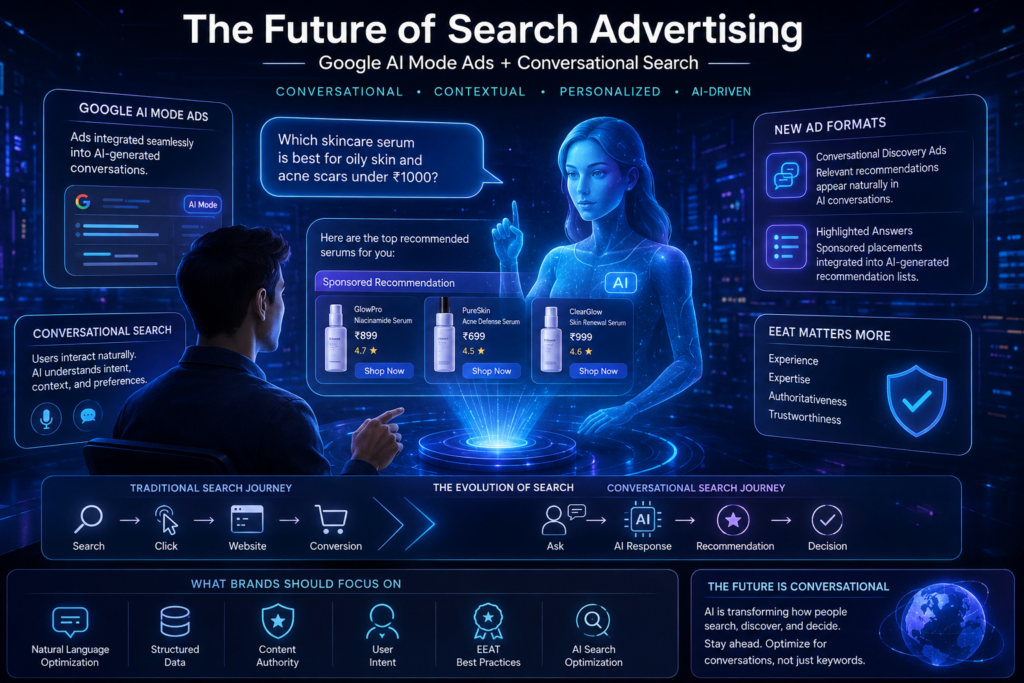
What Are Google AI Mode Ads?
Google AI Mode Ads are new advertising formats designed specifically for Google’s AI-powered conversational search experience.
Instead of displaying ads only within traditional search engine result pages (SERPs), Google Ads AI Mode integrates sponsored placements directly into AI-generated responses.
This creates a more seamless and interactive user experience where ads become part of the conversation rather than separate promotional blocks.
Powered by Gemini AI, Google’s conversational search system can now:
- Understand detailed user intent
- Interpret natural language questions
- Provide contextual recommendations
- Display AI-powered search ads dynamically
This evolution represents one of the biggest changes in AI Search Advertising in recent years.
Why Conversational Search Is Changing Everything
Traditional search behavior was simple.
Users typed short phrases like:
- “best running shoes”
- “cheap hotels near me”
- “buy skincare products”
But Conversational Search works differently.
Users now interact with AI like they are speaking to a real assistant.
Instead of:
“best skincare serum”
People ask:
“Which skincare serum is best for oily skin and acne scars under ₹1000?”
This change matters because AI understands:
- context
- intent
- preferences
- follow-up questions
Google revealed that conversational AI queries are significantly longer and more detailed than traditional searches. This shift is forcing advertisers to rethink how they approach AI Search Advertising.
The New Ad Formats Inside Google Ads AI Mode
Google introduced two major formats within Google Ads AI Mode:
1. Conversational Discovery Ads
2. Highlighted Answers
Both formats are designed specifically for Conversational Search experiences.
Conversational Discovery Ads Explained
Conversational Discovery Ads appear naturally within AI conversations.
Instead of targeting only exact-match keywords, Google’s AI interprets the full meaning behind user questions and serves relevant recommendations dynamically.
Example:
A user asks:
“How can I make my apartment feel like a luxury spa?”
Google’s AI may recommend:
- scented candles
- essential oil diffusers
- spa-inspired home products
through AI-Powered Search Ads integrated directly into the response.
This is fundamentally different from traditional PPC advertising.
The focus is no longer just:
- keywords
- CPC bids
- ad rank
Now, AI Search Advertising revolves around:
- conversational intent
- semantic meaning
- contextual relevance
Highlighted Answers: Sponsored AI Recommendations
The second format, Highlighted Answers, integrates sponsored products or services directly into AI-generated recommendation lists.
For example:
If a user searches for:
“Best apps to learn Spanish”
Google’s AI may recommend educational platforms while displaying sponsored placements naturally within those recommendations.
This creates a new form of Conversational AI Advertising where promotions blend seamlessly into AI-driven answers.
Instead of interrupting users, ads become part of the discovery process.
This is why many marketers believe Google AI Mode Ads could completely reshape digital advertising over the next few years.
Why AI Search Advertising Matters for Brands
The rise of AI Search Advertising changes how businesses compete online.
In traditional search advertising:
- brands optimized for clicks
- rankings drove visibility
- users compared multiple websites
But with Conversational Search, AI increasingly summarizes information before users even visit a site.
That means visibility now depends on:
- trustworthiness
- authority
- structured content
- contextual clarity
This is where EEAT becomes extremely important.
EEAT Matters More Than Ever in AI Search
Google’s AI systems prioritize:
- Experience
- Expertise
- Authoritativeness
- Trustworthiness
Low-quality, keyword-stuffed content struggles in AI-powered environments because AI systems evaluate information credibility more deeply.
Brands that demonstrate:
- genuine expertise
- transparent information
- clear content structure
- trustworthy recommendations
are more likely to succeed in Google Ads AI Mode.
EEAT Best Practices for AI Search Optimization
Businesses should:
- publish expert-driven content
- maintain accurate business information
- build trusted brand mentions
- use reliable citations
- update outdated content regularly
Strong EEAT signals improve visibility in both organic AI responses and AI-Powered Search Ads.
How Google Gemini Advertising Is Influencing Search
A major part of this transformation comes from Gemini AI.
Google Gemini Advertising enables AI systems to:
- analyze landing pages
- summarize product information
- generate contextual explanations
- personalize recommendations
Google confirmed that Gemini can generate AI explainers directly from advertiser websites.
This means your:
- website quality
- landing page structure
- product descriptions
- brand clarity
all influence how AI presents your business.
For brands investing in AI-Driven Search Marketing, this creates both opportunities and challenges.
The Evolution of Search Advertising
The Future of Search Advertising is becoming increasingly AI-driven.
Traditional advertising focused on:
- impressions
- rankings
- keyword targeting
Modern AI Search Advertising focuses on:
- recommendations
- conversations
- predictive intent
- user context
The user journey is also changing.
Traditional Search Journey
Search → Click → Website → Conversion
Conversational Search Journey
Ask → AI Response → Recommendation → Decision
This is why businesses must rethink how they approach AI Search Optimization.
AI Search Optimization: What Brands Should Do Next
To compete effectively in Conversational Search, businesses need a stronger AI-first strategy.
1. Optimize for Natural Language Queries
Create content around real user questions instead of focusing only on short keywords.
Example:
Instead of:
“best protein powder”
Write:
“Which protein powder is best for beginners trying to build muscle?”
This improves visibility in both AI Search Advertising and AI-generated answers.
2. Improve Structured Data
AI systems rely heavily on:
- schema markup
- organized product feeds
- structured website information
Clear structured data improves how Google AI interprets your brand.
3. Strengthen Content Authority
Strong EEAT signals improve trust.
Brands should:
- publish expert-written articles
- include real-world insights
- showcase industry experience
- build reputable backlinks
This supports long-term AI Search Optimization.
4. Focus on User Intent
AI prioritizes helpfulness.
Your content should:
- answer questions directly
- provide clarity quickly
- avoid fluff
- solve real problems
This is critical for success in Conversational AI Advertising.
Challenges Businesses May Face
While Google AI Mode Ads create exciting opportunities, there are challenges too.
1. Reduced Click Traffic
AI-generated summaries may reduce direct website visits.
2. Attribution Complexity
Users may interact with AI multiple times before converting, making tracking more difficult.
3. Less Keyword Control
Traditional PPC allowed precise keyword targeting.
Conversational AI relies more on:
- intent
- context
- semantic understanding
This reduces predictability for advertisers.
Why Early Adoption Matters
The businesses that adapt early to AI-Driven Search Marketing will likely gain a significant advantage.
Right now:
- many brands still focus only on traditional SEO
- few businesses optimize for AI recommendations
- conversational advertising is still emerging
This creates a massive opportunity.
Early adopters can:
- establish AI visibility
- build authority
- improve recommendation frequency
- dominate future search experiences
The Future of Conversational AI Advertising
The rise of Conversational AI Advertising signals a broader transformation in digital marketing.
Search is becoming:
- conversational
- predictive
- personalized
- AI-driven
Users increasingly trust AI-generated recommendations because they feel more contextual and less intrusive than traditional ads.
As Google continues expanding Google AI Mode Ads, businesses will need strategies built specifically for:
- AI Search Advertising
- Conversational Search
- AI Search Optimization
- AI-powered recommendations
Final Thoughts
Google’s new AI ad formats represent more than a feature update.
They mark the evolution of search itself.
The future of advertising will no longer depend only on rankings and keywords. Success will increasingly depend on:
- contextual relevance
- conversational intent
- authority
- trustworthiness
Businesses that invest early in:
- EEAT-driven content
- AI Search Optimization
- AI-Driven Search Marketing
- Conversational Search strategies
will be better positioned for the future of digital visibility.
As AI reshapes how people search, discover, and make decisions, Google AI Mode Ads may become one of the most important shifts in modern search advertising.
Key Takeaway
The future of search advertising belongs to brands that understand conversations, not just keywords.