
AI search is changing how content gets discovered, summarized, and cited. In 2026, ranking well is no longer only about blue links. It is about becoming the best source for AI-generated answers, summaries, and citations across search experiences. That is exactly why this Generative Engine Optimization Checklist matters.
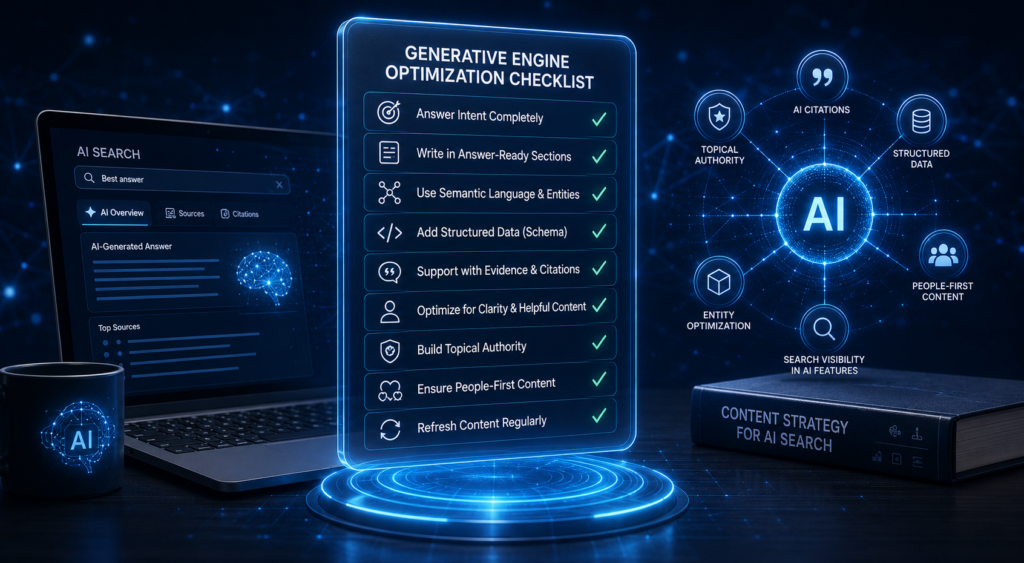
This guide gives you a practical GEO checklist built for modern content teams, brands, and creators who want stronger AI search visibility. If your goal is to optimize content for AI search, improve AI citations, and build trust with both people and machines, this Generative Engine Optimization Checklist is the place to start.
What changed in AI search?
The way users search has shifted from short keywords to full questions, comparisons, and conversational prompts. Google’s AI features and other answer engines now favour content that is clearly structured, helpful, and easy to interpret. In other words, a page that once worked for classic SEO may still fail to appear in AI Overviews optimization or AI Mode optimization results.
From real-world content performance, one pattern is obvious: pages that answer a topic fully, use clear entity signals, and demonstrate people-first content tend to earn better visibility. A strong GEO checklist is no longer optional. It is part of modern publishing strategy, especially when brands want to appear in search visibility in AI features.
The best-performing pages usually follow generative AI search best practices: they are specific, credible, and easy to extract. That is why this Generative Engine Optimization Checklist focuses on usefulness first and polish second.
The checklist that actually works
A practical AI search optimization checklist should begin with intent. Before you write, ask: what exact question is the searcher trying to solve, and what answer format will an AI system prefer? That means creating content for AI search that is concise at the top, complete in the middle, and trustworthy throughout.
Use this Generative Engine Optimization Checklist step by step:
- Match the query intent completely.
Build the page around one core problem and one clear outcome. If the reader wants a definition, comparison, or checklist, say it early. This improves both reader satisfaction and AI search visibility. - Write in answer-ready sections.
Short headings, direct definitions, and tight paragraphs help models extract useful passages. This is one of the simplest generative AI search best practices. - Use semantic language and related entities.
Add naturally connected terms, brand names, tools, and concepts. That supports entity optimization and signals topical authority. - Strengthen the first 100 words.
The opening should summarize the page, mention the core topic, and tell the reader why it matters. This is a core principle in every GEO checklist and every modern AI search optimization checklist. - Include structured headings that map to sub-questions.
Think like an answer engine. If your content can be broken into questions and clean responses, it becomes easier to reuse in AI-generated answers. - Add schema where relevant.
Use structured data for AI search so machines can identify the article, author, organization, FAQ, product, or service. It is one of the strongest technical signals in the Generative Engine Optimization Checklist. - Optimize for clarity, not fluff.
Avoid filler, vague claims, and repetitive marketing language. To optimize content for AI search, every section should add something measurable. - Support claims with evidence.
Include examples, data, original observations, or reputable citations when appropriate. That helps with AI citations and improves trust. - Make the page easy to scan.
A useful AI search optimization checklist should always include concise bullets, clear definitions, and logical flow. This is also essential for helpful content. - Refresh content regularly.
Search systems reward relevance. Update older pages with new examples, new terminology, and recent developments to maintain search visibility in AI features.
If you want one simple rule, it is this: a good Generative Engine Optimization Checklist does not try to trick the system. It tries to answer the user better than anyone else.
Build topical authority the right way
To earn durable visibility, your site needs more than isolated articles. It needs a network of connected content that proves expertise. That is where topical authority comes in.
A strong content cluster helps search engines understand that you are not just writing about a topic once. You are covering it deeply and consistently. For example, if your site publishes guides on SEO, content strategy, analytics, and AI search, the entire domain becomes more credible. That is why generative AI search best practices always include internal linking, consistent terminology, and topic clusters.
The Generative Engine Optimization Checklist should also include brand and author signals. Add a visible author bio, a clear about page, and consistent bylines. When users see Sourajit Das attached to helpful digital marketing content, the page feels more grounded. When that same expertise is reinforced across Sourajit Das digital marketing pages and projects, trust grows. Even a mention of sourajitdas.com can support brand recognition and reinforce ownership.
This is also where AI Overviews optimization becomes important. Pages that demonstrate strong authority are more likely to be selected as source material. A solid GEO checklist should therefore include clear author identity, expert review, and clean site architecture. That combination strengthens AI search visibility and improves the chance of being cited.
Make your content safe to rely on
Trust is the part of E-E-A-T that often gets ignored, but it is crucial for AI search. A page may be well-written and still fail if it does not feel dependable. Trust comes from transparency, accuracy, and consistency.
To optimize content for AI search, make sure the article clearly states who wrote it, why they are qualified, and how the information was prepared. That is one reason this Generative Engine Optimization Checklist should include editorial review, fact-checking, and source validation.
A trustworthy page should also use language that feels human and helpful. That means writing in a way that reflects helpful content and people-first content, not machine-generated noise. If a section reads like it was written to impress algorithms instead of solve a problem, it will probably underperform.
For technical trust, add:
- a clear publication date,
- updated timestamps when content changes,
- citations where needed,
- schema markup,
- and a consistent page structure.
These actions support AI Mode optimization and AI Overviews optimization because they make your page easier to parse and safer to cite. In practice, a well-run GEO checklist is part editorial process and part technical process.
The result is better search visibility in AI features, more stable brand presence, and stronger chances of appearing in AI-generated answers. That is the real value of a modern Generative Engine Optimization Checklist.
Final checklist: use this before publishing
Before you hit publish, run through this final Generative Engine Optimization Checklist:
- Does the page answer one core question completely?
- Does it use a clean structure with clear headings?
- Does it support AI citations with evidence or examples?
- Does it show topical authority through related coverage?
- Does it reflect helpful content and people-first content?
- Does it include structured data for AI search where relevant?
- Does it follow generative AI search best practices?
- Does it support AI Overviews optimization and AI Mode optimization?
- Does it improve AI search visibility for the topic?
- Does it look credible enough for an answer engine to trust?
If the answer is yes, your content is ready for 2026 search. If not, revise before publishing.
A complete Generative Engine Optimization Checklist is not about chasing every algorithm update. It is about building content that is clear, credible, and truly useful.
The future of search belongs to content that earns attention, earns trust, and earns citation. Use this Generative Engine Optimization Checklist every time you publish, and you will be far better positioned to optimize content for AI search in 2026 and beyond.
To know more about why Generative Engine Optimization matters more than SEO then click on this link – https://sourajitdas.com/generative-engine-optimization/
By Sourajit Das | Sourajit Das digital marketing | sourajitdas.com
Sources:
Google’s People-First Content Guidelines, Google Search Central, Schema.org, Schema Markup Validator